FTSE 100 FINISH LINE 15/5/26
FTSE 100 FINISH LINE 15/5/26
Political Premium Returns as Oil Shock Tests the Inflation Trade
UK equities were firmly lower on Friday, with the FTSE 100 down 1.8%, on course to end a two-day winning streak as investors assessed domestic political risk and imported inflation risk at the same time. The immediate catalyst was growing speculation that Greater Manchester Mayor Andy Burnham could position himself for a leadership challenge to Prime Minister Keir Starmer, after announcing plans to contest an upcoming parliamentary vacancy. For markets, the issue is not simply leadership drama — it is the potential fiscal direction of a post-Starmer Labour Party. Burnham’s pitch of “business-friendly socialism” may aim to reassure corporates, but investors focus on the spending and borrowing implications. With UK public finances already stretched and long-end gilt yields recently testing multi-decade highs, the market has little tolerance for any sign that fiscal discipline could weaken. The resignation of Wes Streeting as health minister has further destabilised the political backdrop, with Streeting also seen as a potential contender should a formal challenge emerge. The result is a longer, noisier political process that risks keeping a UK-specific premium embedded in sterling, gilts and domestic equities.
The macro backdrop added to the pressure. Brent crude rose 2.6% to $108.49/bbl after U.S. President Donald Trump signalled diminishing patience with Iran, intensifying concerns over possible disruption around the Strait of Hormuz. For the UK, as a net oil importer, this is a direct inflation risk at the wrong point in the cycle. Higher energy prices threaten real incomes, complicate the disinflation path and limit the Bank of England’s room to lean dovish. Meanwhile, the much-anticipated Trump-Xi meeting failed to deliver enough progress to improve sentiment around China or Gulf risks, leaving global cyclicals with little support.Sector performance reflected the breadth of the risk-off move. Metal miners fell 5.0%, hit by the lack of China optimism and broader de-risking, while utilities dropped 4.9% as higher yield sensitivity, political risk and regulatory concerns converged. The standout exception was 3i Group, which rebounded 5.4% after Thursday’s 12.8% slide, as investors selectively bought the dip following the sell-off linked to slower momentum at key portfolio company Action. Still, the bounce looked more like position clean-up than a genuine shift in risk appetite.
Next week’s UK calendar gives markets plenty of fresh catalysts. The Bank of England speaking schedule is heavy, with Greene and Mann on Monday, Breeden on Tuesday and Taylor on Thursday. Labour-market data arrive Tuesday, CPI on Wednesday, and GfK consumer confidence plus retail sales on Friday. The key release is inflation: headline CPI is expected to ease to 3.0% y/y from 3.3%, broadly in line with the BoE’s April Monetary Policy Report, helped by base effects as last year’s increases in water bills and vehicle excise duty drop out. That means any fresh energy impulse from higher oil prices is unlikely to show cleanly in the headline immediately; investors will need to look inside the components for early signs of pass-through.
The finish line is that the FTSE’s international earnings base is no longer enough to fully shield the index from a domestic repricing. Political uncertainty, higher oil and a dense UK data schedule create an uncomfortable setup for sterling assets. Into next week, the market will be watching three things: whether inflation really cools beneath the surface, whether BoE speakers validate or push back against rate-hike pricing, and whether the Burnham-Starmer story becomes a formal leadership risk. Until those clear, investors are likely to stay defensive, favour global earners and cash-flow quality, and remain selective on UK policy-sensitive beta.
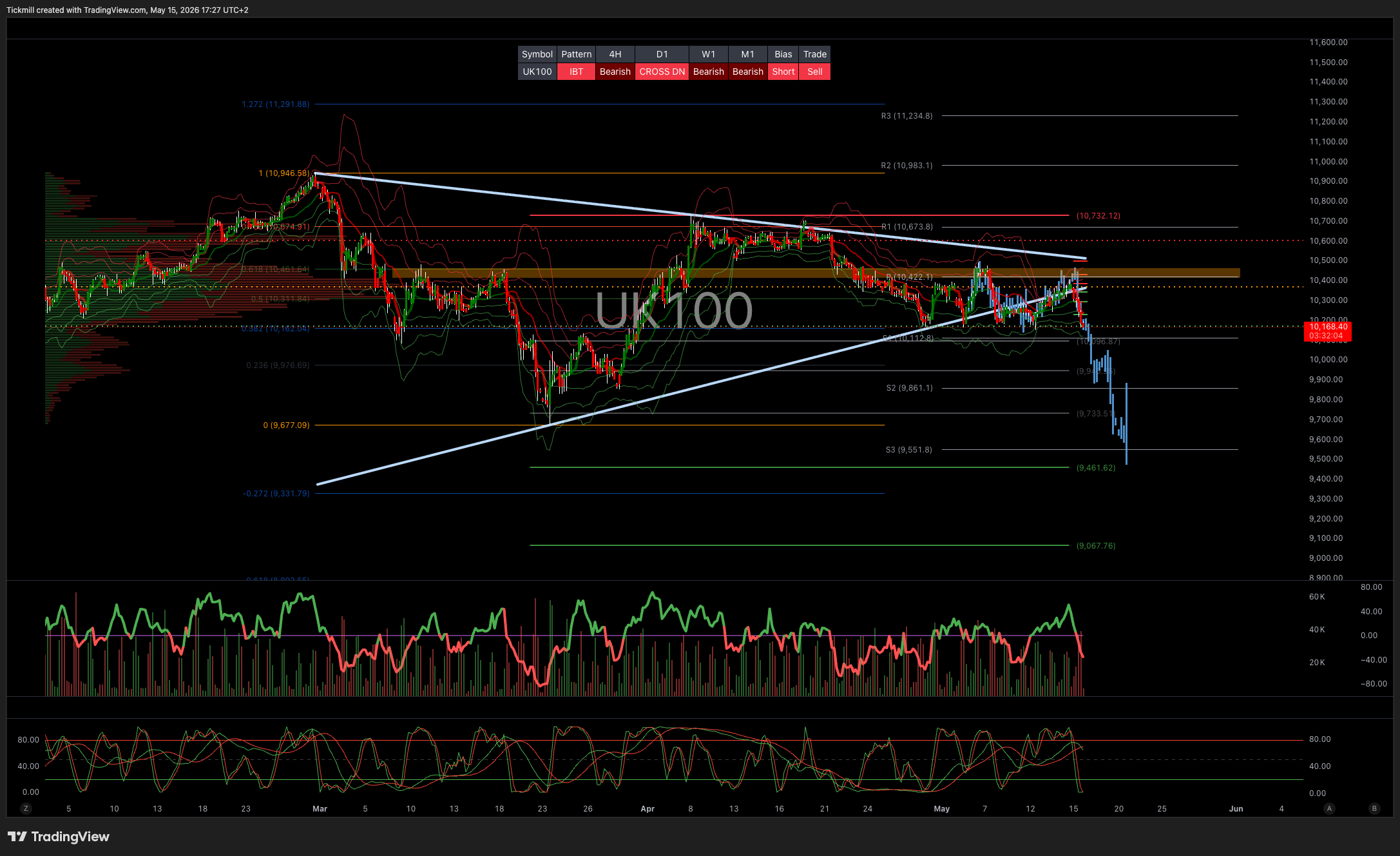
TECHNICAL & TRADE VIEW – FTSE100
Daily VWAP Bearish
Weekly VWAP Bearish
Above 10500 Target 11000
Below 10100 Target 9469
Disclaimer: The material provided is for information purposes only and should not be considered as investment advice. The views, information, or opinions expressed in the text belong solely to the author, and not to the author’s employer, organization, committee or other group or individual or company.
Past performance is not indicative of future results.
High Risk Warning: CFDs are complex instruments and come with a high risk of losing money rapidly due to leverage. 68% and 74% of retail investor accounts lose money when trading CFDs with Tickmill UK Ltd and Tickmill Europe Ltd respectively. You should consider whether you understand how CFDs work and whether you can afford to take the high risk of losing your money.
Futures and Options: Trading futures and options on margin carries a high degree of risk and may result in losses exceeding your initial investment. These products are not suitable for all investors. Ensure you fully understand the risks and take appropriate care to manage your risk.
Patrick has been involved in the financial markets for well over a decade as a self-educated professional trader and money manager. Flitting between the roles of market commentator, analyst and mentor, Patrick has improved the technical skills and psychological stance of literally hundreds of traders – coaching them to become savvy market operators!