FTSE Finish Line: July 13 — Oil Shock Keeps FTSE Cautious as FPC Leverage Reform Offers Gilt Support
FTSE Finish Line: July 13 — Oil Shock Keeps FTSE Cautious as FPC Leverage Reform Offers Gilt Support
London started the week slightly lower, with investors staying cautious as Middle East tensions intensified and oil prices jumped on fears of supply disruption through the Strait of Hormuz. The FTSE 100 avoided a deeper fall thanks to gains in telecoms, housebuilders, recruiters and selected energy names, but the broader tone remained defensive after another round of U.S. and Iranian strikes over the weekend. The immediate driver was geopolitics. The U.S. military launched fresh strikes against Iran overnight and early Monday, saying the aim was to degrade Tehran’s ability to attack commercial ships transiting the Strait of Hormuz. The escalation followed an Iranian strike on a container ship in the critical waterway, including attacks on vessels crossing on the Omani side. Iran then responded by targeting Gulf Arab states, including Bahrain, Kuwait, Qatar, Jordan and Oman, further straining an already fragile ceasefire. President Trump also said the U.S. was reinstating its blockade of ships in and out of Iran while protecting other vessels through Hormuz. He said the U.S. would charge 20% of the value of all cargo shipped to cover the cost of providing security. That announcement added a new layer of uncertainty for markets. A direct U.S. security charge on cargo through a critical energy route would raise shipping costs, complicate insurance pricing and increase the risk of broader trade disruption. Even if the policy is intended to secure shipping rather than restrict it, investors are likely to treat it as another tax on global supply chains. Oil reacted sharply. WTI rose 4.5% to $74.64 a barrel, while Brent climbed 4.4% to $79.38. The move pushed energy risk back to the centre of the UK market debate. For the FTSE 100, higher crude can support BP and Shell. But for the UK economy, it also raises inflation pressure, squeezes household real incomes and complicates the Bank of England’s already difficult policy trade-off. That tension was visible in the market. BP gained between 2% and 3%, and Shell rose between 1% and 1.85%, supported by higher oil prices. But the overall index still drifted lower because investors understand that a Middle East-driven oil rally is not a clean positive. It helps energy earnings, but it can hurt almost everything else through inflation, margins, consumer demand and rates.
The Bank of England backdrop remains central. Near term, higher oil encourages markets to price a higher inflation risk premium. However, the UK’s vulnerability to an energy shock is primarily through the demand channel. As a net energy importer with weak productivity, subdued capital formation and already restrictive monetary conditions, the UK is especially exposed to a real-income squeeze. That means a sustained oil shock could be inflationary in the short run but ultimately dovish over the medium term if it weakens demand enough to pull inflation lower into 2027. The Financial Policy Committee’s leverage reform proposal added a separate policy story. The FPC has proposed a reform package for the UK leverage buffer stack focused on improving domestic systemically important banks’ countercyclical flexibility, simplifying the regime and enhancing the usability and releasability of capital buffers. The FPC reiterated that overall UK bank capital levels remain appropriate, but acknowledged that the UK leverage framework has become more binding than intended relative to international peers. This matters because leverage requirements can restrict banks’ balance-sheet capacity even when risk-weighted capital ratios are strong, particularly for institutions holding large volumes of low-risk assets such as gilts. The proposed reforms are modestly supportive for gilts. In a central case, they could generate around £34 billion of effective gilt demand across the D-SIB universe, implying annual fiscal savings of roughly £1.1 billion. That is not insignificant, especially given elevated borrowing costs and the fiscal constraints facing the next government. But the market should not overstate the effect. The incremental outright gilt demand is likely to be softer than some optimistic estimates across the street. The overall impact appears broadly similar to previous estimates under alternative policy options, meaning it should help at the margin rather than transform the gilt market. It supports balance-sheet capacity, but it does not eliminate the need for fiscal credibility. That distinction matters with Andy Burnham on course to become prime minister. The leadership nomination window remains open until 16 July, but Burnham is still expected to run effectively unopposed, with a transition to party leader on 17 July and prime minister on 20 July if no challenger emerges. Markets are already looking beyond the leadership result to the Chancellor appointment and the fiscal framework. The OBR’s recent fiscal risks report, warning that debt could rise above 150% of GDP by 2055 and beyond 300% by 2075 without policy action, keeps the pressure on. The incoming government will need to show how it can fund defence, infrastructure, public services and growth priorities without unsettling the gilt market. FPC leverage reform can support gilt demand at the margin, but it cannot substitute for a credible fiscal plan.
On the stock front, Vodafone extended its deal-driven momentum, rising nearly 4.5%. The stock remained supported after last week’s news that UAE telecom group e& plans to divest its stake to the family investment vehicle of French billionaire Xavier Niel. The rally reflects renewed expectations around shareholder influence, consolidation, restructuring and capital discipline in a sector long viewed as undervalued. Telecoms were broadly firmer, with BT Group up 2% to 3%. The move suggested investors continue to favour names where corporate activity, infrastructure value or defensive cash-flow characteristics can offset macro uncertainty. Housebuilders and housing-linked names also performed well. Persimmon gained 2% to 3%, while Barratt Redrow rose between 1% and 1.85%. Kingfisher also advanced. That resilience was notable given the weak housing and construction backdrop, including last week’s RICS survey showing the house-price balance still negative at -33%. Investors may be positioning for eventual rate relief if higher energy prices ultimately damage demand and turn policy more accommodative later. Recruiters were another bright spot. PageGroup soared 11.7% after reporting second-quarter gross profit above market expectations, while Grafton Group added nearly 2% after reporting first-half trading growth and maintaining full-year adjusted operating profit guidance. The strength in PageGroup followed Friday’s surge in Hays, which guided annual operating profit toward the upper end of forecasts. Together, the updates suggest recruitment firms are benefiting from cost discipline and productivity improvements even as the broader labour market remains soft. Computacenter gained 2% to 3%, while Sage rose between 1% and 1.85%, showing continued investor interest in technology and software-linked UK names with resilient demand. This follows Bytes Technology’s recent update showing strong trading in software, AI and cloud services. However, the BoE’s warning about leveraged AI equity exposure remains a background risk for the broader technology trade. Other gainers included JD Sports, Airtel Africa, Pearson, Entain, Severn Trent, Sainsbury’s, Metlen Energy & Metals and Burberry. The mix of winners was broad but selective, suggesting investors were willing to buy individual stories rather than take a strong directional view on the whole market. On the downside, IG Group fell nearly 3% after last week’s strategic restructuring news, while Polar Capital Technology Trust, IAG, AstraZeneca, Scottish Mortgage, St. James’s Place and Standard Chartered slipped between 1.5% and 2%. Fresnillo, Endeavour Mining, British American Tobacco, Rentokil and Rolls-Royce also moved notably lower. The weakness in IAG and travel-linked names reflected the Middle East escalation and oil-price jump. Higher fuel prices and renewed airspace or security concerns are a direct headwind for airlines, even though easyJet’s takeover speculation helped travel sentiment last week. The market is now distinguishing between corporate-event upside and deteriorating operating costs. AstraZeneca remained under pressure after last week’s near-10% fall following the failed late-stage Wainua cardiovascular-related mortality endpoint. The stock’s continued weakness matters for the FTSE because of its size and defensive role. When AstraZeneca cannot act as a stabiliser, the index becomes more reliant on energy, banks and miners to absorb shocks.
Finish Line: The FTSE 100 slipped slightly as renewed U.S.-Iran escalation and a 4% jump in oil kept investors cautious. BP and Shell gained, but the broader market struggled with the inflation, demand and shipping-cost implications of a more unstable Strait of Hormuz. Vodafone extended its deal-driven rally, PageGroup surged on stronger-than-expected gross profit, and housebuilders gained on hopes that a demand-damaging energy shock may ultimately pull rates lower. The FPC’s leverage reform proposal is a modest positive for banks and gilts, potentially generating around £34 billion of effective gilt demand and £1.1 billion of annual fiscal savings, but it is not a silver bullet. The market still needs credible fiscal policy from the incoming Burnham government, calmer energy markets and clearer evidence that the UK slowdown is not turning into something worse.
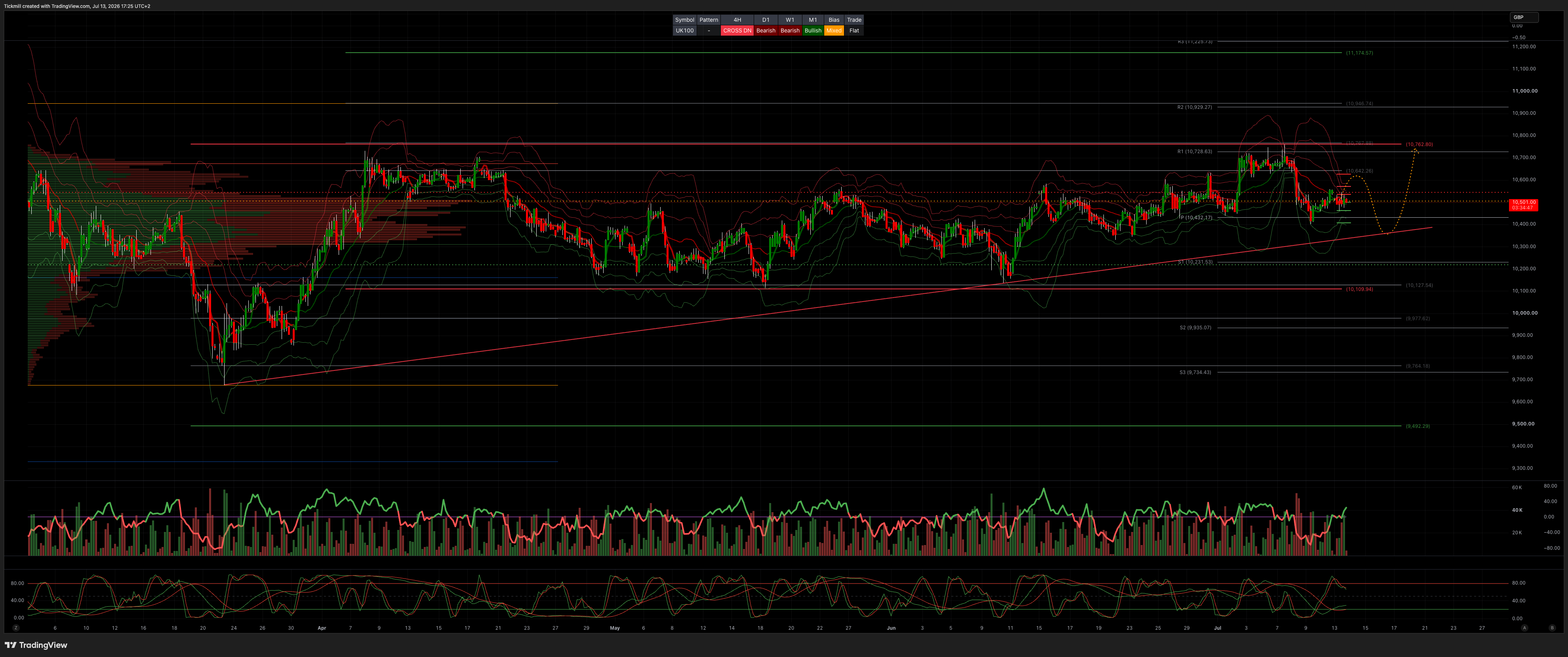
TECHNICAL & TRADE VIEW – FTSE100
Daily VWAP Bearish > Bullish
Weekly VWAP Bearish
Above 10300 Target 11000
Below 10100 Target 9469
Disclaimer: The material provided is for information purposes only and should not be considered as investment advice. The views, information, or opinions expressed in the text belong solely to the author, and not to the author’s employer, organization, committee or other group or individual or company.
Past performance is not indicative of future results.
High Risk Warning: CFDs are complex instruments and come with a high risk of losing money rapidly due to leverage. 68% and 74% of retail investor accounts lose money when trading CFDs with Tickmill UK Ltd and Tickmill Europe Ltd respectively. You should consider whether you understand how CFDs work and whether you can afford to take the high risk of losing your money.
Futures and Options: Trading futures and options on margin carries a high degree of risk and may result in losses exceeding your initial investment. These products are not suitable for all investors. Ensure you fully understand the risks and take appropriate care to manage your risk.
Patrick has been involved in the financial markets for well over a decade as a self-educated professional trader and money manager. Flitting between the roles of market commentator, analyst and mentor, Patrick has improved the technical skills and psychological stance of literally hundreds of traders – coaching them to become savvy market operators!