FTSE Rebounds Late as Energy Surges Above $112, Rentokil Rally Offsets Banking Drag
FTSE Rebounds Late as Energy Surges Above $112, Rentokil Rally Offsets Banking Drag
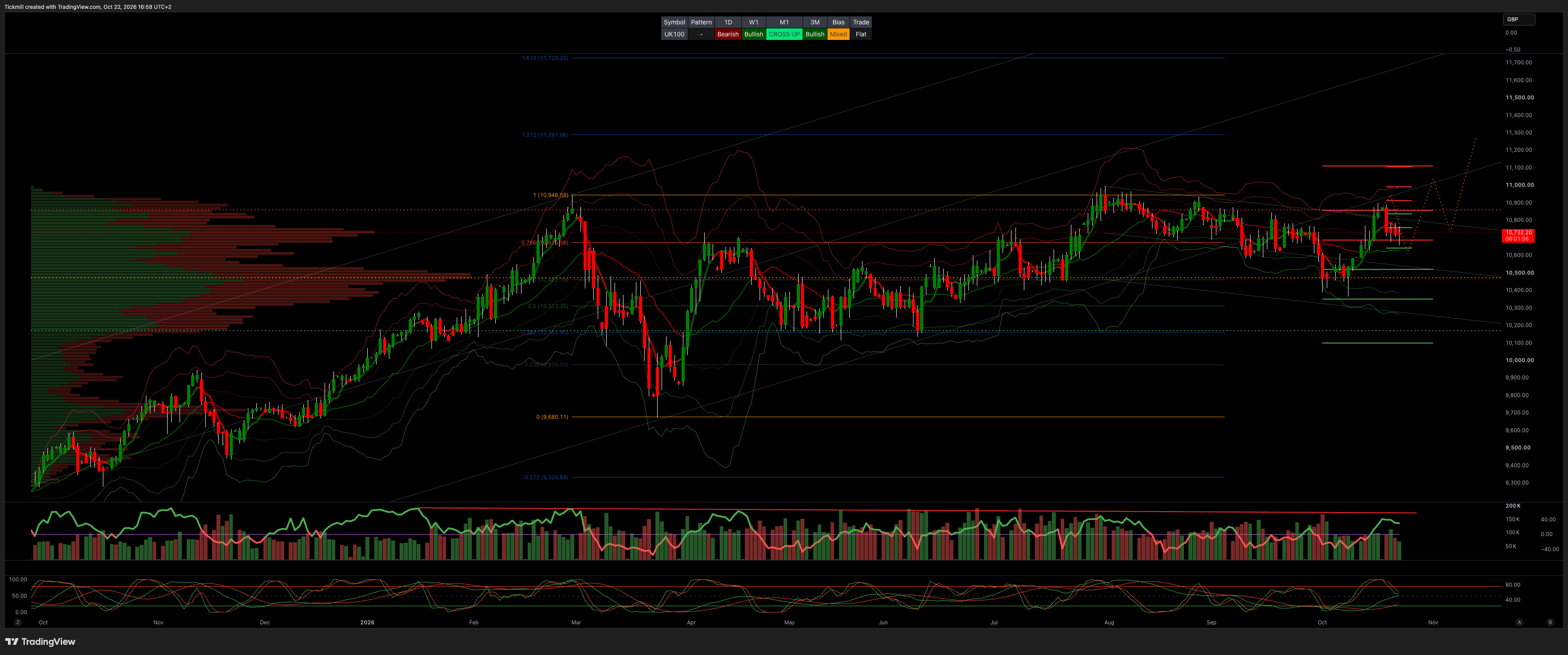
London's benchmark FTSE 100 mounted a late-day recovery on Thursday to turn green on the session, overcoming an initial drop to one-week lows. An early sell-off driven by bank earnings misses, metal price pullbacks, and persistent inflation anxieties was erased into the close as surging crude oil prices propelled energy heavyweights and strong corporate results provided targeted top-flight support.
Corporate updates drove significant divergence across sectors. Pest control specialist Rentokil Initial topped the FTSE 100 with an 8.2% surge following stronger Q3 organic revenue growth and the launch of a $200 million share buyback plan. London Stock Exchange Group (LSEG) gained 4.3% after raising its full-year 2026 revenue guidance and agreeing to acquire financial data provider Octus for $3.54 billion. Energy majors Shell, BP, and Ithaca Energy rallied strongly alongside crude oil. Conversely, domestic banking heavyweights traded near June lows, with Barclays dipping marginally after missing Q3 profit forecasts and announcing plans to cut 5,000 jobs. Retail and hospitality counters also faced selling pressure: Sainsbury’s dropped 3.7% on slowing Q2 sales growth, while InterContinental Hotels Group (IHG) fell 3.1% as rate hikes and Middle East conflict concerns overshadowed a Q3 RevPAR beat. Precious and industrial miners were the day's largest percentage decliners, with Anglo American and Antofagasta losing over 3% to 4% as spot gold and copper prices slipped over 1%.
Macro sentiment was dominated by energy market spikes and central bank rate expectations. Front-month Brent crude futures jumped over 3% to trade above $112 a barrel—hitting their highest levels since May—as geopolitical risks in the Middle East continued to threaten supply lines. Rebounding energy prices reinforced U.K. inflation concerns following Wednesday's hotter-than-expected September CPI reading (3.5% y/y, services inflation up to 3.7%), fully cementing market expectations for a Bank of England rate hike in November.
On the fixed income and structural market front, sovereign debt curves digested competing forces of growth moderation and energy-driven inflation. September Public Sector Net Borrowing printed at £24.5 billion (£6.0 billion above year-to-date OBR forecasts), highlighting fiscal pressures ahead of the upcoming Budget. Meanwhile, for U.K. fixed-income desks, the structural relationship between Quantitative Tightening (QT) and front-end Gilt asset-swap (ASW) spreads has decoupled. While earlier reserve depletion mechanically drove two-year Gilt ASW widening, widespread adoption of the Bank of England’s Short-Term Repo (STR) facility has mitigated reserve scarcity by allowing commercial banks to replace drained reserves with central bank repo liquidity. Consequently, Gilt cheapening ahead of the Budget is expected to translate through term premia and auction concessions rather than mechanical QT reserve drag.
Finish Line: U.K. equities staged a resilient late-session rally to close in positive territory as surging crude oil above $112 and earnings-driven gains in Rentokil and LSEG absorbed heavy selling across banks and miners. While sticky inflation metrics and expanding public borrowing reinforce expectations for a November BoE rate hike, energy sector strength helped the FTSE 100 navigate macro friction.
Disclaimer: The material provided is for information purposes only and should not be considered as investment advice. The views, information, or opinions expressed in the text belong solely to the author, and not to the author’s employer, organization, committee or other group or individual or company.
Past performance is not indicative of future results.
High Risk Warning: CFDs are complex instruments and come with a high risk of losing money rapidly due to leverage. 68% and 74% of retail investor accounts lose money when trading CFDs with Tickmill UK Ltd and Tickmill Europe Ltd respectively. You should consider whether you understand how CFDs work and whether you can afford to take the high risk of losing your money.
Futures and Options: Trading futures and options on margin carries a high degree of risk and may result in losses exceeding your initial investment. These products are not suitable for all investors. Ensure you fully understand the risks and take appropriate care to manage your risk.
Patrick has been involved in the financial markets for well over a decade as a self-educated professional trader and money manager. Flitting between the roles of market commentator, analyst and mentor, Patrick has improved the technical skills and psychological stance of literally hundreds of traders – coaching them to become savvy market operators!